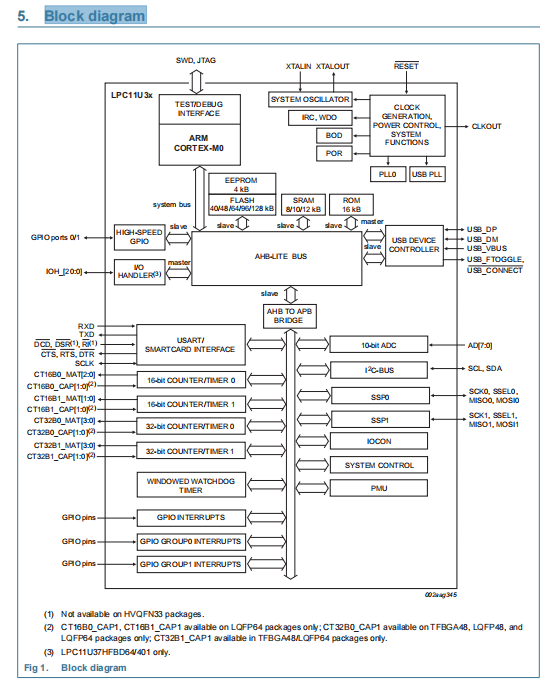
4 kB on-chip EEPROM data memory; byte erasable and byte programmable;
on-chip API support.
Up to 12 kB SRAM data memory.
16 kB boot ROM.
In-System Programming (ISP) and In-Application Programming (IAP) via on-chip
bootloader software.
ROM-based USB drivers. Flash updates via USB supported.
ROM-based 32-bit integer division routines.
Debug options:
Standard JTAG (Joint Test Action Group) test interface for BSDL (Boundary Scan
Description Language).
Serial Wire Debug.
Digital peripherals:
Up to 54 General Purpose I/O (GPIO) pins with configurable pull-up/pull-down
resistors, repeater mode, and open-drain mode.
Up to 8 GPIO pins can be selected as edge and level sensitive interrupt sources.
Two GPIO grouped interrupt modules enable an interrupt based on a
programmable pattern of input states of a group of GPIO pins.
High-current source output driver (20 mA) on one pin.
High-current sink driver (20 mA) on true open-drain pins.
Four general purpose counter/timers with a total of up to 8 capture inputs and 13
match outputs.
Programmable Windowed WatchDog Timer (WWDT) with a dedicated, internal
low-power WatchDog Oscillator (WDO).
Analog peripherals:
10-bit ADC with input multiplexing among eight pins.
Serial interfaces:
USB 2.0 full-speed device controller.
USART with fractional baud rate generation, internal FIFO, a full modem control
handshake interface, and support for RS-485/9-bit mode and synchronous mode.
USART supports an asynchronous smart card interface (ISO 7816-3).
Two SSP controllers with FIFO and multi-protocol capabilities.
I2C-bus interface supporting the full I2C-bus specification and Fast-mode Plus with
a data rate of up to 1 Mbit/s with multiple address recognition and monitor mode.
I/O Handler for hardware emulation of serial interfaces and DMA; supported through
software libraries. (LPC11U37HFBD64/401 only.)
Clock generation:
Crystal Oscillator with an operating range of 1 MHz to 25 MHz (system oscillator).
12 MHz high-frequency Internal RC oscillator (IRC) that can optionally be used as
a system clock.
Internal low-power, low-frequency WatchDog Oscillator (WDO) with programmable
frequency output.
PLL allows CPU operation up to the maximum CPU rate with the system oscillator
or the IRC as clock sources.
A second, dedicated PLL is provided for USB.
Clock output function with divider that can reflect the crystal oscillator, the main
clock, the IRC, or the watchdog oscillator.
Power control:
Integrated PMU (Power Management Unit) to minimize power consumption during
Sleep, Deep-sleep, Power-down, and Deep power-down modes.
Power profiles residing in boot ROM provide optimized performance and minimized
power consumption for any given application through one simple function call.
Four reduced power modes: Sleep, Deep-sleep, Power-down, and Deep
power-down.
Processor wake-up from Deep-sleep and Power-down modes via reset, selectable
GPIO pins, watchdog interrupt, or USB port activity.
Processor wake-up from Deep power-down mode using one special function pin.
Power-On Reset (POR).
Brownout detect with up to four separate thresholds for interrupt and forced reset.
Unique device serial number for identification.
Single 3.3 V power supply (1.8 V to 3.6 V).
Temperature range 40 C to +85 C.
Available as LQFP64, LQFP48, TFBGA48, and HVQFN33 packages.
Applications
Consumer peripherals
Handheld scanners
Medical
USB audio devices
Industrial control