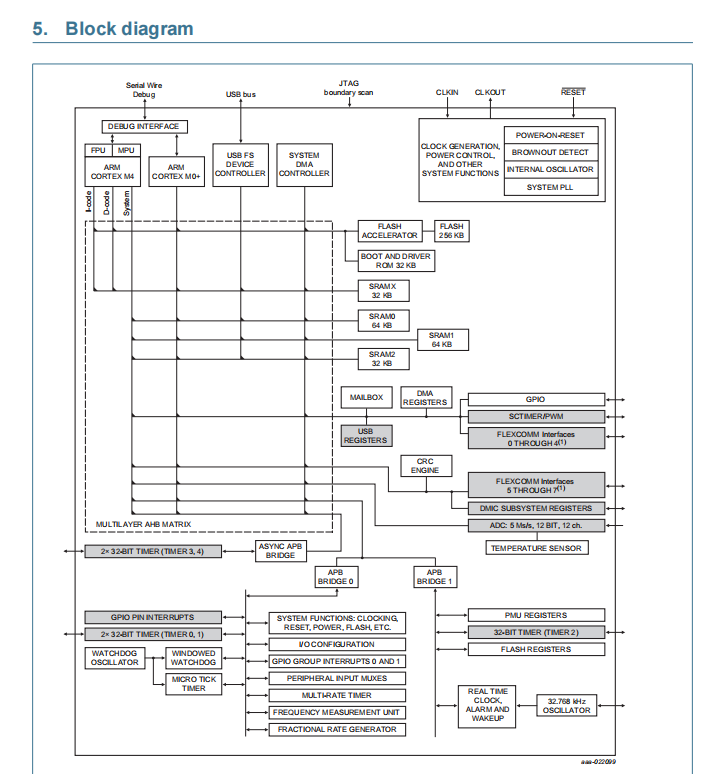
ARM Cortex-M0+ core
ARM Cortex-M0+ processor, running at a frequency of up to 150 MHz (uses the
same clock as Cortex-M4) with a single-cycle multiplier and a fast single-cycle I/O
port.
ARM Cortex-M0+ built-in Nested Vectored Interrupt Controller (NVIC).
Non-maskable Interrupt (NMI) input with a selection of sources.
Serial Wire Debug with four breakpoints and two watch points.
System tick timer.
On-chip memory:
Up to 256 KB on-chip flash program memory with flash accelerator and 256 byte
page erase and write.
Up to 192 KB total SRAM consisting of 160 KB contiguous main SRAM and an
additional 32 KB SRAM on the I&D buses.
ROM API support:
Flash In-Application Programming (IAP) and In-System Programming (ISP).
ROM-based USB drivers (HID, CDC, MSC, and DFU). Flash updates via USB is
supported.
Supports booting from valid user code in flash, USART, SPI, and I2C.
Legacy, Single, and Dual image boot.
Serial interfaces:
Flexcomm Interface contains eight serial peripherals. Each can be selected by
software to be a USART, SPI, or I2C interface. Two Flexcomm Interfaces also
include an I2S interface. Each Flexcomm Interface includes a FIFO that supports
USART, SPI, and I2S if supported by that Flexcomm Interface. A variety of clocking
options are available to each Flexcomm Interface and include a shared fractional
baud-rate generator.
I2C-bus interfaces support Fast-mode and Fast-mode Plus with data rates of up to
1Mbit/s and with multiple address recognition and monitor mode. Two sets of true
I2C pads also support high speed mode (3.4 Mbit/s) as a slave.
USB 2.0 full-speed device controller with on-chip PHY and dedicated DMA
controller supporting crystal-less operation in device mode using software library.
See Technical note TN00031 for more details.
Digital peripherals:
DMA controller with 20 channels and 20 programmable triggers, able to access all
memories and DMA-capable peripherals.
Up to 48 General-Purpose Input/Output (GPIO) pins. Most GPIOs have
configurable pull-up/pull-down resistors, programmable open-drain mode, and
input inverter.
GPIO registers are located on the AHB for fast access.
Up to eight GPIOs can be selected as pin interrupts (PINT), triggered by rising,
falling or both input edges.
Two GPIO grouped interrupts (GINT) enable an interrupt based on a logical
(AND/OR) combination of input states.
CRC engine.
Analog peripherals:
12-bit ADC with 12 input channels and with multiple internal and external trigger
inputs and sample rates of up to 5.0 MSamples/sec. The ADC supports two
independent conversion sequences.
Integrated temperature sensor connected to the ADC.
DMIC subsystem including a dual-channel PDM microphone interface, flexible
decimators, 16 entry FIFOs, optional DC locking, hardware voice activity detection,
and the option to stream the processed output data to I2S.
Timers:
Five 32-bit standard general purpose timers/counters, four of which support up to
four capture inputs and four compare outputs, PWM mode, and external count
input. Specific timer events can be selected to generate DMA requests. The fifth
timer does not have external pin connections and may be used for internal timing
operations.
One SCTimer/PWM with eight input and eight output functions (including capture
and match). Inputs and outputs can be routed to or from external pins and internally
to or from selected peripherals. Internally, the SCTimer/PWM supports ten
captures/matches, ten events, and ten states.
32-bit Real-time clock (RTC) with 1 s resolution running in the always-on power
domain. A timer in the RTC can be used for wake-up from all low power modes
including deep power-down, with 1 ms resolution.
Multiple-channel multi-rate 24-bit timer (MRT) for repetitive interrupt generation at
up to four programmable, fixed rates.
Windowed Watchdog Timer (WWDT).
Clock generation:
12 MHz internal Free Running Oscillator (FRO). This oscillator provides a
selectable 48 MHz or 96 MHz output, and a 12 MHz output (divided down from the
selected higher frequency) that can be used as a system clock. The FRO is
trimmed to 1 % accuracy over the entire voltage and temperature range.
External clock input for clock frequencies of up to 25 MHz.
Watchdog oscillator (WDTOSC) with a frequency range of 6 kHz to 1.5 MHz.
32.768 kHz low-power RTC oscillator.
System PLL allows CPU operation up to the maximum CPU rate without the need
for a high-frequency external clock. May be run from the internal FRO 12 MHz
output, the external clock input CLKIN, or the RTC oscillator.
Clock output function with divider.
Frequency measurement unit for measuring the frequency of any on-chip or
off-chip clock signal.
Power control:
Programmable PMU (Power Management Unit) to minimize power consumption
and to match requirements at different performance levels.
Reduced power modes: sleep, deep-sleep, and deep power-down.
Wake-up from deep-sleep modes due to activity on the USART, SPI, and I2C
peripherals when operating as slaves.
The Micro-Tick Timer running from the watchdog oscillator can be used to wake-up
the device from any reduced power modes.
Power-On Reset (POR).
Brown-Out Detect (BOD) with separate thresholds for interrupt and forced reset.
Single power supply 1.62 V to 3.6 V.
JTAG boundary scan supported.
128 bit unique device serial number for identification.
Operating temperature range 40 °C to +105 °C.
Available as WLCSP49 and LQFP64 packages.